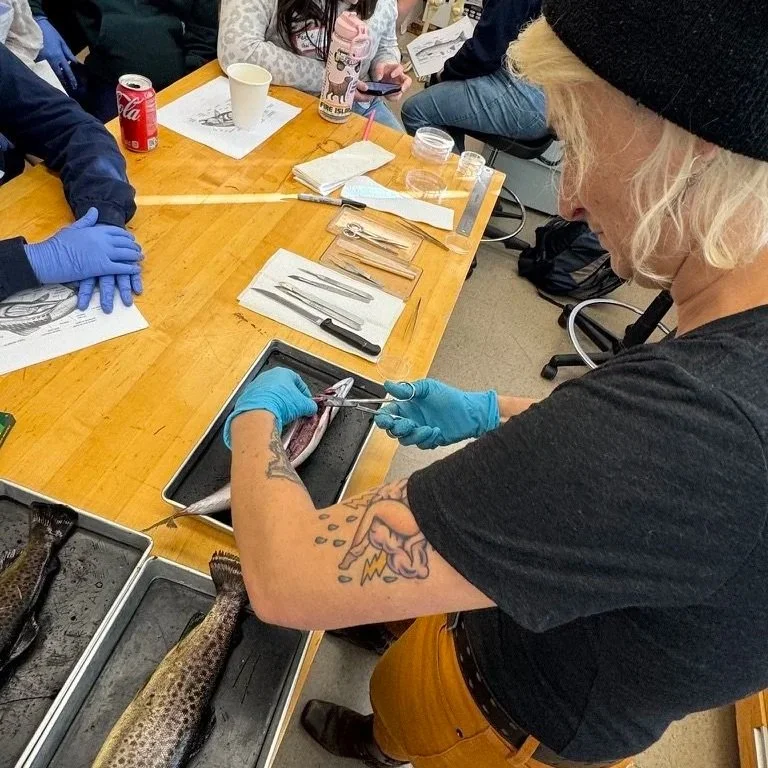
I currently teach undergraduate courses at Hampshire College in Amherst, MA. This funky little liberal arts college has a long history of pushing the boundaries of what higher education is and should be in an ever changing world. The student experience is unique and designed for self-directed education and transdisciplinary exploration. Arts and sciences are often co-investigated by my students and my curriculum is designed in the context of identity, problem solving, and social justice.
Hampshire College courses
Animal Behavior Theory
In this class, we will actively discuss assigned readings about the theory of animal behavior and how it is applied in the context of specific taxa, environments, conservation status, and cultural perspectives. We will visit (and revisit) Niko Tinbergen’s Four Questions and their relevance to understanding, quantifying, and describing animal behavior. Weekly Animal Observation Journal entries will be summarized and submitted at the end of the semester. We will visit the Hampshire College Farm and camera trap sites in the Hampshire Woods to contextualize our understanding. Students will complete a term paper describing the state of animal behavior research on a species of their choice. Students will also lead an in-class discussion on a published study of their choosing relevant to a chapter in the textbook. Creativity is encouraged and kindness is required. (Fall 2025)
Animal Behavior Methods
This hands-on field course will cover research methods for observing, coding, and analyzing animal behavior. We will practice behavior sampling and recording techniques on domestic animals at the farm, wild animals in the campus woods, and captive animals in the lab. We will use tools and equipment for measuring and tracking behaviors, including social behavior, foraging, and communication behavior. Students will carry out independent projects on a species in the Hampshire woods, the Farm, or the lab and will be expected to consult the primary scientific literature to learn about their species. We will examine how to summarize, analyze, and present data using spreadsheets and basic R Statistical Software to make figures and graphs. Papers and presentations will be due for each project. (Fall 2025)
Animal Migrations
Animal migrations are a core component of ecosystem functioning and connectivity. Movement of animals across different habitats transfers nutrients, modulates disease processes, and supports dynamic food webs. In this course, we will review and discuss current literature describing animal migrations across terrestrial, marine, and aquatic habitats. Students will learn about the role of animal migration in local and regional ecology and the behaviors that contribute to coordinated movements of populations. We will read and discuss peer-reviewed literature that identifies the array of behavioral mechanisms and environmental and biological stimuli involved in animal migration across taxa. We will contextualize this knowledge within our understanding of climate change impacts and the sociopolitical complexities of wildlife management across borders. (Spring 2026)
Coastal Resilience, Climate Change, & Socio-Ecological Perspectives
Coasts are on the front lines of climate change, experiencing firsthand the effects of increasing sea level, storm severity and frequency, and ocean temperature and acidification. Human and animal communities that occupy coastal habitats are almost certainly or soon-to-be affected by climate change. In this course, students will examine coastal change through a transdisciplinary lens. We will review examples of successful and unsuccessful mitigation strategies and the co-development of climate action plans, with a focus on partnering with Indigenous peoples. Students will engage in role-play and scenario-planning activities to develop equitable solutions to emerging problems facing coastal human and animal communities. (Spring 2026)
Underwater Animal Behavior
We will use examples from peer reviewed literature and foundational theory to engage in interactive discussions about the diversity of subaqueous animal behavior. As a class, we will investigate innate and learned behaviors of fishes, mammals, and other taxa across aquatic, marine, and brackish environments from the poles to the tropics. Students will complete independent projects that investigate a specific animal behavior of interest in the context of fitness outcomes, evolutionary underpinnings, and adaptive capacity under climate change and urbanization. Techniques for monitoring and quantifying underwater animal behavior will be integrated into class discussions and student projects. (Fall 2026)
Cognition on the Farm
This course centers on supporting independent research by students that characterizes the cognitive capacities of animals housed at the Hampshire College Farm. As a class, we will discuss the conceptual frameworks and theoretical underpinnings of physical and social cognition of farm animals. Students will design independent studies to explore the specific cognitive capacities of farm animals relating to object permanence, numerical ability, tool use, individual discrimination and recognition, fairness, and other topics. We will discuss these capacities in the context of ethical and welfare considerations as well as broader contexts for animal behavior research. Student findings will be shared with the broader community through a series of oral, written, and creative presentations. (Fall 2026)
Measuring Fish Behavior
This hands-on course will immerse students in the techniques, approaches, and tools used to quantify fish behavior across spatial and temporal scales. We will review, discuss and apply traditional and emerging approaches for measuring fish behavior in captivity and the wild, such as acoustic and radio telemetry, hydrophone and video monitoring, biosampling (e.g. otolith microchemistry, stable isotope analysis, genomics), and statistical modeling using existing data. Students will lead independent projects that characterize the behavior of a captive or wild population in the context of environmental conditions, life history traits, and other relevant factors. Students will conduct literature reviews on their focal species and observed behaviors to develop comprehensive research presentations supported by science, practice and theory. (Spring 2027)
Cognition in the Wild
The cognition of wild animals is an elusive topic to explore given the challenges related to measuring cognition of animals in a natural ecological context. This course will delve into these complex questions by discussing cognition theory in the context of peer-reviewed literature. Topics will include emerging techniques for measuring cognition in the wild, characterization of underlying mechanisms, and relevance to animal behavior theory and applications. Concepts such as spatial memory and navigation, social learning, decision-making, and tool use will be investigated. Independent and group activities will help students to solidify these concepts by designing studies of wild animal cognition for species of interest. (Spring 2027)

Photo by Laura Owens Lambert